
Science Fiction has a reputation for being… dense. It’s easy to feel lost before you even start, facing down intimidating classics, complex physics, and series that span dozens of books. But what if you could find all the mind-bending wonder—the epic scales, the strange new worlds, and the “what if?” questions that define the genre—in a single, unputdownable novel?
Welcome to the world of Gateway Science Fiction.
This isn't a new genre, but rather a powerful wave of modern science fiction that has become incredibly engaging for a new generation of readers. These books distill the best parts of the genre—its massive ideas, its sense of awe, its exploration of what it means to be human—into thrilling, accessible stories that don't require a physics degree to enjoy.
Need proof? Look no further than Adrian Tchaikovsky’s Children of Time. It’s a book built on a staggering premise: What if the last remnants of humanity, fleeing a dead Earth, pin their hopes on a newly terraformed planet… only to find it was accidentally seeded with a virus that fast-tracked the evolution of a species of spiders?
It's a breathtaking, award-winning epic that is as much a page-turner as it is a profound exploration of civilization, consciousness, and conflict. Children of Time is the perfect example of a gateway book: it's not “sci-fi lite,” it's “sci-fi right.”
What Are The Top Gateway Sci-Fi Books?

Battlefield Earth, by L. Ron Hubbard (2016)
In the year 3000, Earth has been stripped and poisoned by the Psychlos, and the last pockets of humanity scrape by in hidden valleys and ruined cities. Jonnie Goodboy Tyler refuses to accept that this is all that’s left. He leaves his mountain village to learn what happened to the wider world and is seized by the invaders, marched into a vast mining complex where humans work and die under watchful alien eyes.
Jonnie chooses study over surrender. He learns the Psychlo language, maps out their systems, and reads their blind spots. A ruthless overseer named Terl thinks he can turn this sharp human into a tool for a private gold scheme, but the plan cuts both ways. Jonnie recruits scattered survivors, revives lost skills, and turns scavenged tech into leverage. What starts as a con inside a mine grows into a coordinated bid for freedom, with strikes that hit the Psychlos where they least expect it and a final push that gambles everything on nerve and timing.
In my mind, it’s a big, pulpy ride that wears its heart on its sleeve. I included it despite the slightly older publication date because it’s a proven, high-energy gateway sci-fi, easy to hand to newcomers who want a straight-ahead human-vs-aliens epic.

When the Moon Hits Your Eye, by John Scalzi (2025)
Virgil Augustine runs a small museum in Ohio and wakes up to a lunar problem that shouldn’t exist. The moon rock has… changed, the moon itself seems wrong, and reality starts wobbling in ways that demand quick thinking rather than solemn lectures. That’s the lane Scalzi loves big, weird premise, brisk trouble, lots of dialogue that snaps.
It’s a standalone caper with science fiction bones and sitcom timing, the kind of book you can read after a long day and still follow every beat. In my mind: this is the friendliest door into modern SF this year—light on homework, high on fun.
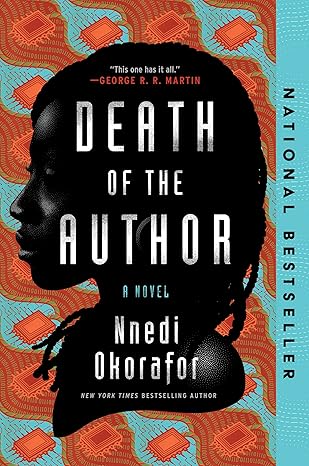
Death of the Author, by Nnedi Okorafor (2026)
Zelu has long felt out of step with her Nigerian family, choosing writing over prestige or marriage. After being fired during her sister’s Caribbean wedding and receiving yet another rejection, she starts a project for herself: a far-future epic where androids and AI battle in the overgrown ruins of human civilization, titled Rusted Robots.
Sharing the manuscript launches her into unexpected fame and a messy reckoning over what the book becomes in other hands. Framed as a book-within-a-book, Death of the Author follows Zelu from Chicago to Lagos to space, blurring the line between creator and creation while showing how stories can reshape both people and the world that follows.

We Lived on the Horizon, by Erika Swyler (2025)
In a fortified post-cataclysm city ruled by an AI that rewards sacrifice, renowned bio-prosthetic surgeon Saint Enita Malovis faces the end of her career and builds Nix, a physical vessel encoded with her knowledge, to carry on her work. When a fellow elite “Sainted” is murdered and the city’s AI deletes the evidence, Enita and Nix uncover cracks in Bulwark’s carefully managed order and are pulled into a rising conflict between the hidden underclass and the systems that control them.
The novel follows their search for truth and legacy while probing the lure of utopia, the boundaries of the body, and the shifting line between human and machine.
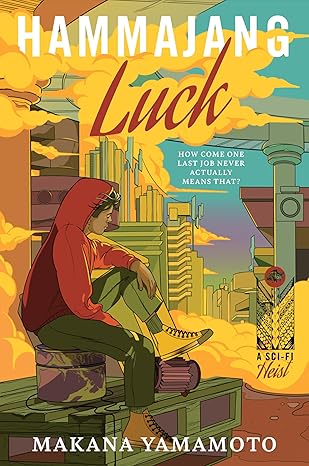
Hammajang Luck, by Makana Yamamoto (2025)
Edie spent eight years on an icy prison world after Angel betrayed her during their biggest heist on Kepler Station. She wants a clean break from crime and to regain lost time. Early parole drops her back into the light, and Angel is there waiting.
Angel wants another shot at the same trillionaire tech boss they failed to bring down. It could mean payback and a path forward, but it requires Edie to trust her again. With Hawai‘i in her bones and Kepler’s neon ahead, she has to decide if the risk is worth it or if this plan will go all hammajang again.
I think the real strength here is the fraught, slow-burn trust battle between Edie and Angel, a knot of loyalty and hurt that drives every choice and keeps the tension honest.
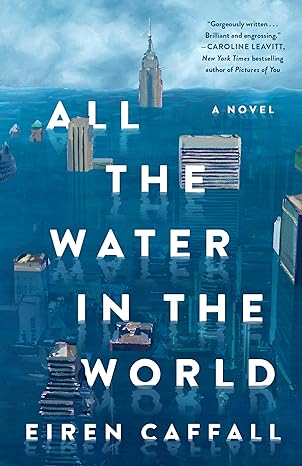
All the Water in the World, by Eiren Caffall (2025)
In a near-future New York after the glaciers melt, Nonie, her sister, and their parents live atop the American Museum of Natural History with a small circle of researchers. They grow and hunt in Central Park and follow a strict rule to touch the exhibits only in real need while they catalog and protect what remains. When a superstorm breaks the city’s defenses, they flee up the Hudson carrying a book of records that lists lost collections and the knowledge they’re trying to preserve.
Their river journey becomes a test of survival and purpose as they meet communities that have adapted in starkly different ways. Inspired by real curators who safeguarded culture during war, the story blends flight, danger, and hard choices with a steady belief that love, work, community, and knowledge can outlast collapse.
I think the novel’s greatest strength is how it braids an intimate family story with the larger question of what’s worth saving after collapse. The museum rooftop, the river escape, and that ledger of lost collections keep the stakes personal while quietly arguing for culture as survival, not ornament.
From Story to Practice: Using Sci-Fi to Make Better Real-World Decisions
Gateway sci-fi isn’t just a list to tick off; it’s a way to practice thinking with your hands on the wheel. Try reading in small daily bursts and, after each session, note one change the story would force in the real world. Not the flashy stuff. The boring parts that actually decide things: maintenance schedules, new training, who gets access, who gets left behind. When teams start piloting humanoid robots, the questions sound the same. Who supervises the hand-offs. What happens on night shift. How do we measure “good enough” before rollouts.
Make it social. Read with a friend or a teen and trade one question rather than a review. Did the characters win because of tools or because they trusted each other. If the tech failed for a day, what kept their plan alive. These are small prompts, but they build a muscle you can use at work, in community plans, or when a new device lands in your house.
Keep it light. Pair an audiobook with an ebook, walk while a chapter plays, and jot a quick voice note at the end. Over time you’ll build a map of ideas that actually helps you decide, not just imagine.
Final Thoughts on the Top Gateway Sci-Fi Books
Gateway sci-fi works because it lowers the on-ramp. You get momentum first, definitions later. The stories hand you a world that moves, then sneak in the “how” and “why” once you care. That order matters. Curiosity turns into literacy fast when the plot is clear, the stakes feel human, and the ideas are shown rather than lectured.
It also points forward. Today’s entry points are tomorrow’s toolkits, shaping how people think about systems, risk, agency, and trade-offs. The best of these books leave you with a habit of asking, “What would this change in us, not just around us?” That question is worth carrying into meetings, policies, and kitchen-table plans. It keeps wonder tethered to consequence.
We’re already living the warm-up drills. Companies are testing general-purpose robots on factory floors and in warehouses, and teams are starting to experiment with Tesla’s humanoid bots in controlled tasks. That’s not a movie trailer. It’s a reminder that the distance between “what if” and “what now” is shrinking. Gateway sci-fi helps more people join that conversation early, with clearer eyes and steadier hands.
Find further sci-fi reads in our philosophical science fiction book collection.


My profession is online marketing and development (10+ years experience), check my latest mobile app called Upcoming or my Chrome extensions for ChatGPT. But my real passion is reading books both fiction and non-fiction. I have several favorite authors like James Redfield or Daniel Keyes. If I read a book I always want to find the best part of it, every book has its unique value.











 English (US) ·